Real range of an electric motorbike: what to really expect
Range is the question that worries people most when buying an electric motorbike, and the one spec sheets answer worst. Here we explain why real range is always lower than the type-approved figure, what it depends on, how to estimate yours for how you ride in Mallorca, and how to look after the battery so it lasts.
Updated 29 September 2026 · By the Motos Eléctricas Mallorca team
In this guide
- Why real range is lower than the spec sheet
- How much it drops: what we see in real use
- How to estimate your real range before buying
- Removable or fixed battery: the decision that matters most
- Where and how to charge in Mallorca
- How to look after the battery so the range lasts for years
- What we do in the workshop about range
Why real range is lower than the spec sheet
The figure on the spec sheet comes from a type-approval cycle: a test under controlled conditions, at a moderate, steady speed, with no hills, no wind and a rider of standard weight. It is useful for comparing bikes with each other, because they all go through the same test. But it is not your journey.
On the road, things come into play that the test does not cover: acceleration, braking, traffic lights, hills, the weight of the rider and what they carry, temperature, wind and, above all, speed. Each one takes kilometres off. Together, they take off quite a few.
This is not the brands cheating, nor is it unique to electric bikes. It happens to a petrol motorbike too, but since you refuel in two minutes nobody measures it. On an electric bike you notice it because charging takes hours and the battery gauge is always in view.
How much it drops: what we see in real use
There is no single figure, and be wary of anyone who gives you one. What we can tell you is what our customers tell us and what we have checked ourselves.
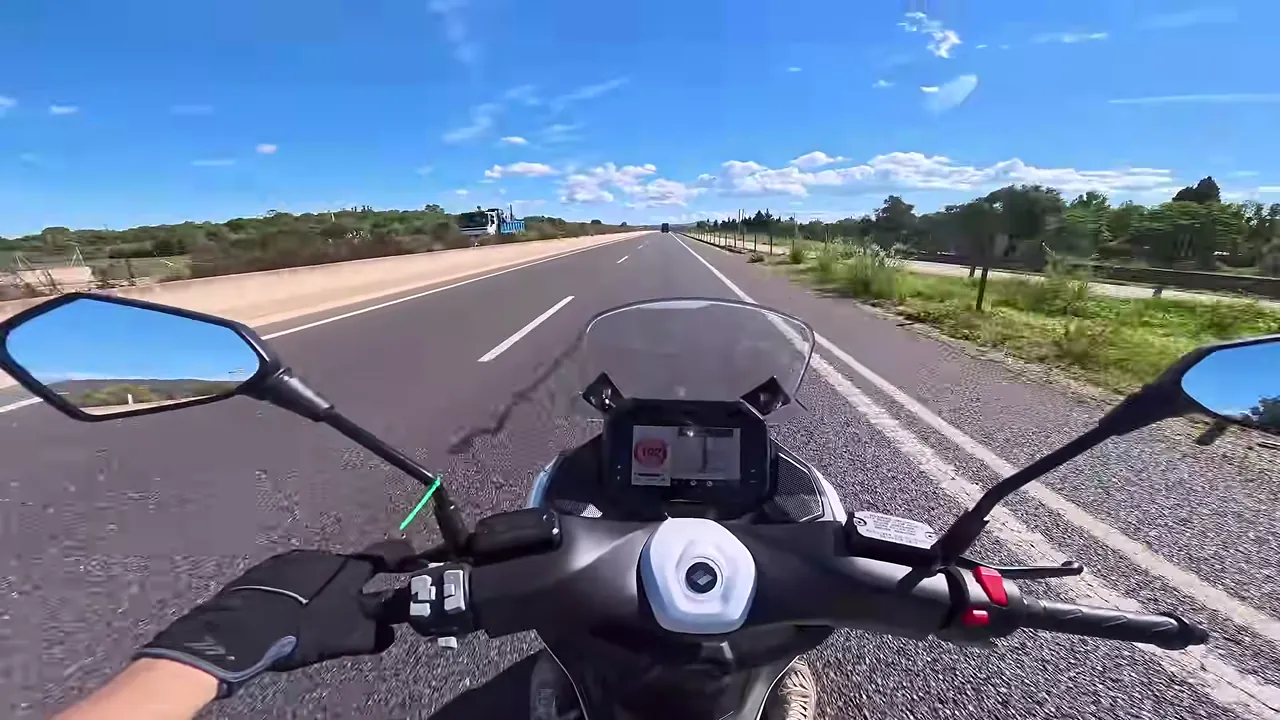
In gentle town riding, at low speeds and with lots of stops, real range gets quite close to the type-approved figure, because the bike recovers energy when braking and hardly suffers from air resistance. Sustained open-road speed is where it falls furthest short: air resistance grows a lot with speed, and at 90 or 100 km/h consumption can be considerably higher than at 50.
As a guide, and only as a guide: allow a clear margin below the spec sheet if you are going to ride on the open road, and a smaller margin if your use is town riding. With a passenger or in the cold, or on a journey that is all uphill, take off a bit more. The best thing is to measure it with your bike and your journey in the first week, and from then on you will know.
- High sustained speed: the factor that uses the most energy.
- Hills: much of the extra used going up is recovered coming down, so on a round trip through the Serra the route figure holds; on a journey that is all uphill, allow a margin.
- Total weight: rider, passenger, luggage.
- Temperature: cold reduces the battery's usable capacity; extreme heat wears it out.
- Under-inflated tyres: they use more energy and brake worse.
- Riding style: full throttle at every traffic light comes at a price.
How to estimate your real range before buying
Start with your journey, not the bike. Add up the kilometres you ride on a normal day, there and back, and add a margin for the unexpected: the errand, the detour. That number, multiplied by 1.5, is what the bike should give you in real use for peace of mind.
Then look at what kind of journey it is. If it is almost all town, with traffic lights and low speeds, the spec sheet will serve as a reference without much of a cut. If it includes the ring road, the motorway or open road at a good pace, cut it a lot and choose a bike with more battery than you think you need.
And think about charging. If you can charge every night, the range you need is one day's. If you can only charge at work or every other day, it has to be double. With this in hand, the list of models narrows itself down.
To do the sums with a specific bike and your journey, use our range calculator: you pick the bike and where you are going in Mallorca, and it tells you whether you will make it and with how much battery left.
Removable or fixed battery: the decision that matters most
Many of our scooters have a removable battery: you take it out, carry it up to your home and charge it from any socket. It is the solution for anyone living in a flat without a garage, which in Palma is a lot of people. Some take a second or third battery to extend range, each with its own weight and price.
Bikes with more range usually have a bigger, fixed battery. They give more kilometres per charge, but you need to park the bike near a socket or a charging point. Some take a Type 2 connector, the same as electric cars, and can charge at public points.
Neither is better than the other: it is about what fits your home. If you have a garage with a socket, either. If you don't, removable, no question. It is the first thing we ask in the shop.
Where and how to charge in Mallorca
At home, from a normal socket, is the usual and cheapest way. A removable battery charges from a household socket with no installation at all. A fixed-battery bike can too, if the cable reaches; for faster charging, those with Type 2 can use a wall charger or a public point.
At work, more and more companies offer a socket for their staff's electric motorbikes. It is worth asking: charging during the working day doubles your margin without changing bikes. How to set it up in a company, in electric motorbike fleets: where they charge.
In a shared garage, Spanish law recognises the right to install a charging point in your space by notifying the residents' association, with no need for approval at a meeting, and the cost is borne by whoever installs it. We can guide you on the procedure; the installation is done by an electrician.
How to look after the battery so the range lasts for years
The lithium batteries in today's motorbikes are designed for many charge cycles and years of use. They lose capacity little by little, not all at once, and there are habits that speed this up and habits that slow it down.
What looks after it: charging with the original charger, not leaving it completely flat for weeks, keeping it out of the sun in summer, and if the bike is going to stand for a long time, storing it at a medium charge in a cool place. There is no need to run it completely flat before charging: that was for other chemistries.
What wears it out: extreme heat, repeated discharges to zero and chargers that are not its own. And one more thing: the battery is the expensive part of the bike. Treating it well is the difference between a bike that is still doing its journey after five years and one that isn't.
- Charge with the original charger, always.
- Don't leave it at zero per cent for weeks.
- Avoid direct sun in summer and intense cold when charging.
- If you store it for months, leave it half charged and check it now and then.
- If you notice a sudden drop in range, bring it in: it can be diagnosed in the workshop.
What we do in the workshop about range
If you ever notice the bike is doing fewer kilometres than usual, the first step is not to replace the battery. We check the tyre pressure, the brakes to make sure they are not dragging, the battery connection and the condition of the cells with the manufacturer's diagnostics. Usually the explanation is simple.
We are the official workshop for the ten brands we sell, with their diagnostic equipment and genuine parts. If the battery had a problem, the warranty is handled from here with the brand. And if you are unsure what range you need before buying, the test ride is free: the best way to find out is to ride your journey on the bike.
Frequently asked questions
How much real range does an electric motorbike have?
It depends on the bike, your journey and how you ride. The spec-sheet figure is a reference for comparing models; in real use allow a margin below it, larger the more open road and speed there is. For daily town use in Palma, most models in the range cover the day comfortably.
Why does my electric motorbike do fewer kilometres in winter?
Cold temporarily reduces the usable capacity of lithium batteries. In Mallorca the effect is moderate, but you notice it on cold January mornings. When the temperature rises, the range comes back. It is not a fault.
Is a bike with two removable batteries better than one with a big fixed battery?
If you don't have a garage with a socket, removable ones: you charge them at home. If you have somewhere to plug the bike in and ride a lot of kilometres, the big fixed one usually gives more range for the same weight. Your home decides, not the spec sheet.
Can I charge the bike at a car charging point?
Yes. Models with a Type 2 connector charge directly; the others, with a Type 2 to household socket adapter, which we have in the shop. The adapter does not charge any faster: the bike charges at its usual power. At points that have the cable already attached, only bikes with Type 2 can charge. We show it on each bike's page.
How long does an electric motorbike take to charge?
It depends on the size of the battery and the charger. A removable scooter battery usually charges overnight from a normal socket; big bikes with Type 2 can do it in a few hours with a suitable charger. Check the charging time on each model's page.
How many years does the battery last?
Today's batteries are designed for years of daily use and lose capacity gradually. Each manufacturer gives a specific warranty for the battery, which we tell you about when you buy. Charging habits make a big difference: treated well, it lasts longer.